Electrical Overstress
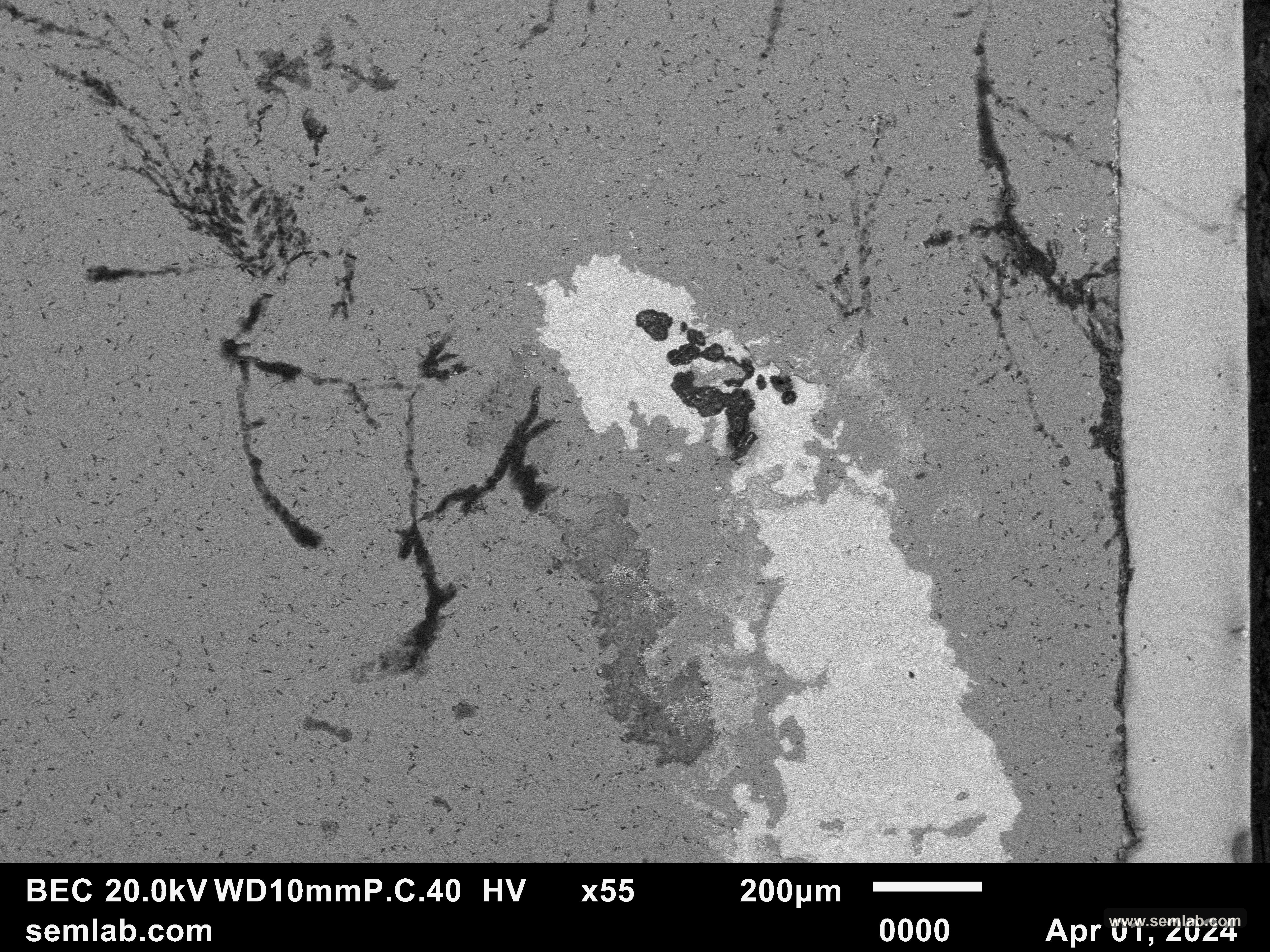
Primary EOS Site In Diode
Localized internal diode damage that supports primary-site interpretation rather than showing only late-stage burned aftermath.
Interpretation
Why this image matters
The report concluded that the shorted diode was most likely caused by electrical overstress from a high-voltage transient, with no evidence that a component-quality problem contributed to the failure.
The image alone does not identify the electrical waveform or circuit source. The transient attribution is the source investigation's most likely interpretation.
This is a clean primary-site reference. The visible damage is localized enough to keep the focus on where the failure initiated rather than on generalized collateral damage.
It pairs well with more dramatic EOS images because it shows that true primary evidence can be subtle and still diagnostically stronger.
eos
diode
primary-site
high-voltage-transient
Use this when
Best comparison value
- Reference: primary EOS-site interpretation in a semiconductor structure
- Comparing localized internal damage to broader thermal aftermath
- Showing EOS evidence that is mechanism-specific rather than just dramatic
Related content