
Technical Paper
Silver corrosion can be a material problem, a contamination problem, or both.
Silver-bearing conductors, terminations, and plated features can fail by sulfur attack, moisture-assisted corrosion, or migration under electrical bias. The useful analysis question is not simply whether silver is present, but whether the location, chemistry, morphology, and electrical symptom all point to the same mechanism.
Source basis
This paper restructures an internal silver-corrosion case review into a public,
website-readable technical reference. Case numbers are retained as internal
examples, but customer-specific details are omitted.
Overview
Silver is used in electronics because it is highly conductive and compatible with many thick-film, plating, termination, and interconnect systems. That usefulness does not make silver immune to reliability problems. In the wrong environment, silver-bearing features can corrode, migrate, or become part of a leakage path.
The recurring pattern across the reviewed cases is that silver corrosion rarely stands alone. It usually appears with at least one enabling condition: sulfur exposure, ionic contamination, moisture, voltage bias, plating discontinuity, handling residue, or an exposed edge where the local metallurgy is vulnerable.
Key Takeaways
- Silver sulfide formation is especially important on silver-bearing thick-film conductors and terminations.
- Electrical bias can turn contamination and moisture into leakage, migration, and conductive bridging.
- Plating defects or thin barrier layers can expose silver to environments it was not intended to see.
- EDS chemistry is most useful when it is tied to the failure site, not merely to nearby residue.
- The strongest conclusions connect morphology, chemistry, location, and the electrical symptom.
Evidence Path
A disciplined silver-corrosion review starts with site relevance. Silver, sulfur, oxygen, chlorine, sodium, potassium, or other residue elements may be analytically interesting, but they become failure-analysis evidence only when they are located on the conductor, termination, bond pad, leakage path, or interface involved in the reported failure.
SEM imaging documents the morphology: crystalline corrosion products, dendritic or filamentary growth, surface roughening, metal loss, blistering, or plating discontinuity. EDS then helps test whether the chemistry is consistent with the proposed mechanism. Electrical history and environmental context complete the interpretation.
Internal Case Patterns
| Case | Assembly or Feature | Primary Interpretation |
|---|---|---|
| 226 | Hybrid headers | Plating damage and contamination were associated with corrosion beneath or through protective metal layers. |
| 819 | Thick-film PCBA mounting pads | Brown residue was interpreted as silver oxide associated with bias-driven movement from silver-bearing pads. |
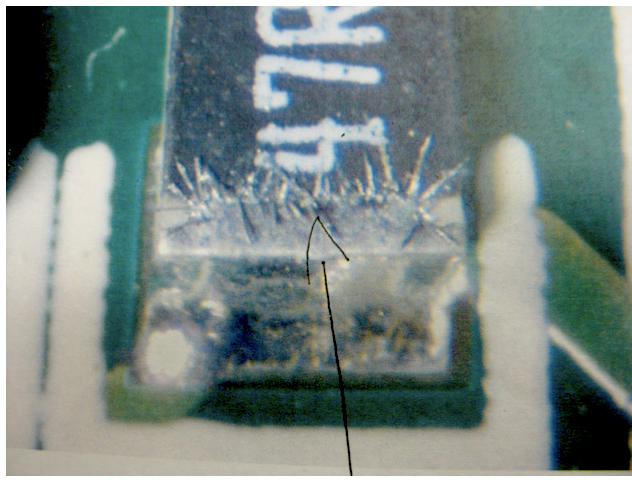
| 1783 | 3 kOhm thick-film resistors | Sulfur corrosion attacked silver-rich conductor edges and contributed to resistor failure. |
| 1911 | Four-resistor set | One sample failed in a pattern consistent with sulfur corrosion and possible packaging or plating contribution. |
| 1933 | Memory IC leadframe plating | Electrical leakage was attributed to corrosion and migration involving silver-bearing leadframe features. |
| 1939 | Microsection follow-up | Silver-rich dendritic features required careful interpretation because preparation artifacts can mimic migration. |
| 1988 | 0603 resistors | Resistor failures were consistent with sulfur attack on silver-bearing termination or conductor material. |
| 2926 | Contaminated PCBA | Halide and sulfur contamination created conditions compatible with corrosion and possible migration. |
Mechanisms
Sulfur-Induced Silver Corrosion
Silver readily reacts with sulfur-containing species to form silver sulfide. In electronics, this matters most where silver is exposed at resistor terminations, thick-film conductor edges, plated layers, or damaged protective finishes. The resulting corrosion can increase resistance, create opens, or weaken an already marginal conductive path.
Moisture, Ionic Contamination, and Bias
Silver corrosion and migration become more likely when moisture and ionic residue are present between biased conductors. The sequence may begin as contamination- assisted leakage, progress through localized corrosion or dissolution, and end with conductive growth or a short. In that situation, calling the event only "corrosion" may hide the enabling role of contamination and electrical bias.
Plating Discontinuity and Barrier Failure
Protective plating can reduce silver exposure, but only when the barrier is continuous and appropriate for the environment. Thin areas, pores, pinholes, handling damage, or exposed cut edges can give moisture and contaminants access to silver-rich layers underneath.
Preparation and Interpretation Artifacts
Dendritic or silver-rich features in a microsection should be interpreted cautiously. Chemical preparation, sectioning, polishing, or local smearing can redistribute material. The strongest migration conclusions come from matching morphology and chemistry at the original failure site, before preparation has had a chance to alter the evidence.
Questions Engineers Usually Ask
Does sulfur in EDS prove sulfur corrosion?
No. Sulfur supports the interpretation when it is located on the relevant silver-bearing feature and paired with corrosion morphology, metal loss, or an electrical symptom. Sulfur found nearby, or in a mixed residue away from the active failure site, is weaker evidence. Spectral identification must also account for overlapping peaks and contributions from nearby material. Barium sulfate (BaSO4), an inert inorganic solder-mask filler, can contribute sulfur without establishing a corrosive sulfur source or silver-sulfide formation.
Is silver oxide the same problem as silver sulfide?
They point to different environmental conditions and may carry different corrective actions. Oxygen-rich material may indicate oxidation, mixed residue, or exposed metal in a moist environment. Sulfur-rich corrosion on silver-bearing features points more directly toward sulfide formation or sulfur exposure.
When should electromigration be included in the conclusion?
Include migration when the evidence shows a biased path, conductive growth or bridging, and chemistry consistent with transported metal. If only corrosion product is present, the conclusion should stay closer to corrosion or contamination-assisted corrosion until the migration path is demonstrated.
Practical Actions
- Document the exact location of corrosion product relative to the failed electrical path.
- Use SEM imaging to separate crystalline growth, metal loss, residue films, and handling debris.
- Use EDS on the suspect feature and on nearby background material for comparison.
- Review sulfur sources, packaging materials, storage conditions, process chemicals, and rubber or foam materials near silver-bearing parts.
- Review humidity exposure, cleaning quality, ionic residue risk, and voltage bias across suspect spacing.
- Verify plating coverage, barrier integrity, exposed edges, and termination geometry.
- Use pre-section imaging whenever possible before destructive preparation can redistribute silver-rich material.
Conclusion
Silver corrosion is best treated as a mechanism family rather than a single simple root cause. The reviewed cases show sulfur attack, contamination-assisted leakage, electromigration, and plating-related exposure all appearing in silver-bearing systems. A strong failure-analysis conclusion should identify the silver-bearing feature, the local chemistry, the physical morphology, and the way those findings explain the reported electrical failure.
Focused Review
Need help deciding whether silver corrosion is causal or incidental?
Purchase the 9-page PDF for the full technical paper, or submit SEM images, EDS spectra, photos, electrical symptoms, and process context for a focused written interpretation of the likely failure mechanism and evidence limits.