Answer first
Decision-oriented findings
Key findings appear before the detailed discussion so engineers and managers can quickly understand the mechanism, limits, and practical significance.

Free 10-page sample report
Solder-Flux-Associated Failures in Electronic Assemblies demonstrates how SEM Lab connects electrical behavior, failure-site location, microscopy, elemental chemistry, process history, and evidence limits in a clear written deliverable.
This public paper is a composite technical example built from anonymized SEM Lab evidence. A client report is tailored to the submitted hardware, question, and available evidence.
What the sample demonstrates
The value is in connecting observations to the reported symptom, testing competing explanations, and stating the conclusion at the level the evidence supports.
Key findings appear before the detailed discussion so engineers and managers can quickly understand the mechanism, limits, and practical significance.
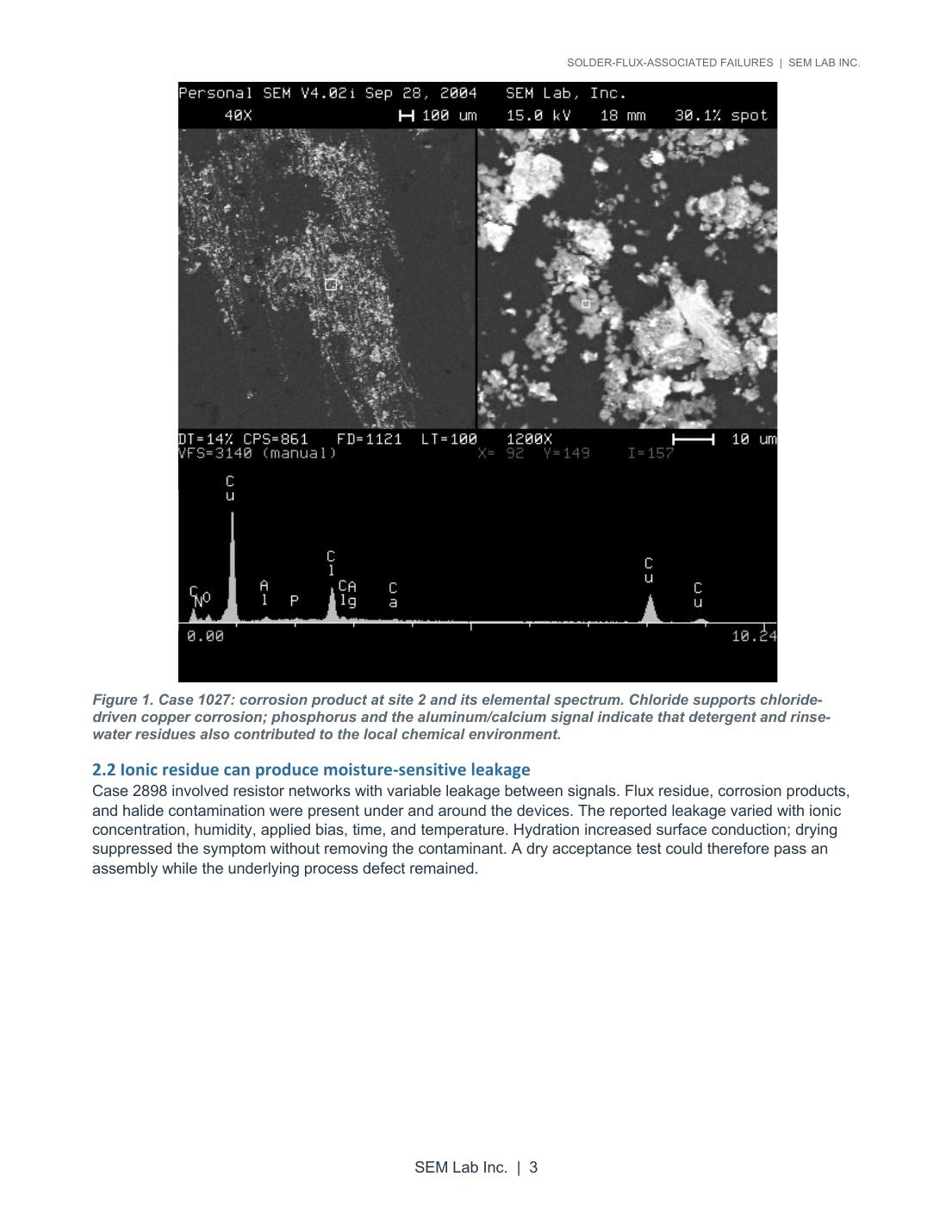
Micrographs, EDS sites, spectra, electrical behavior, and process history remain linked so the reader can follow how each conclusion was reached.
The report separates what was observed from what it means, identifies alternative sources, and avoids turning a residue or elemental peak into unsupported proof.
Inside the report
The sample follows retained residue through different endpoints rather than treating each symptom as an unrelated category.
The report then converts those findings into a practical analysis sequence and manufacturing-process controls.
Engineering usefulness
Strong failure analysis does more than name a contaminant. It identifies the conditions that complete the mechanism and the process controls that can interrupt it upstream.
Review the example
The public sample is free. A paid review applies the same evidence discipline to the files and question submitted through the SEM Lab intake process.