Case 1134 · Public preview
Changing Solder Alloy Can Exchange One Filter-Connector Failure Mechanism for Another
Cross-sections of ceramic filter-connector joints made with two solder alloys contained different interfacial, microstructural, and mechanical reliability concerns.
Metallographic microsectioningBackscattered-electron SEMEDSElemental dot mappingIntermetallic area-fraction measurement
What the evidence preview establishes
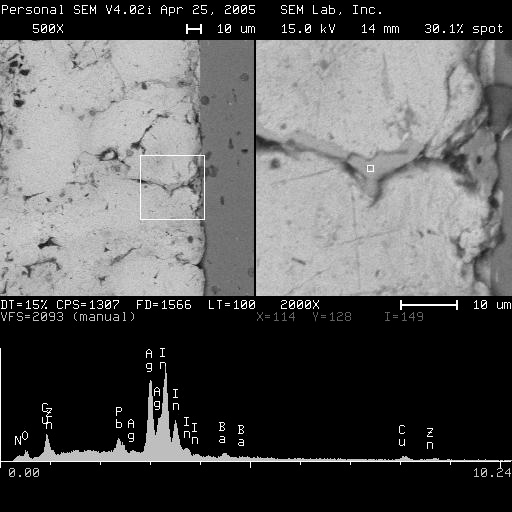
Neither alloy was trouble-free. The 62Sn-36Pb-2Ag joints dissolved the pin gold, contained approximately 13% AuSn4 by area, and repeatedly damaged the ceramic hole walls, while 50In-50Pb retained the gold but formed substantial Ag-In reaction product at grain boundaries and locally damaged the silver termination.
Why this case matters
Evaluate a solder-alloy change as a complete metallurgical system. Gold solubility, silver-terminal compatibility, intermetallic distribution, creep behavior, and stress transferred into the ceramic may improve or worsen independently; an appropriate barrier layer may be required to isolate the silver termination.
Full evidence reserved for MEMBER and STOREThe complete case includes the evidence sequence, four interpreted figures, alternative explanations, limitations, and practical application guidance.